
Space Maintainers for Kids: Why They Matter After Losing a Baby Tooth Early
Quick answer: Space maintainers are small custom appliances, usually made of metal, that hold open the gap left when a child loses a baby tooth too early. Without one, nearby teeth can drift into the space and block the adult tooth from coming in straight, which can lead to crowding and braces later. Most kids get used to them within a few days, and they’re removed once the adult tooth starts to come in.
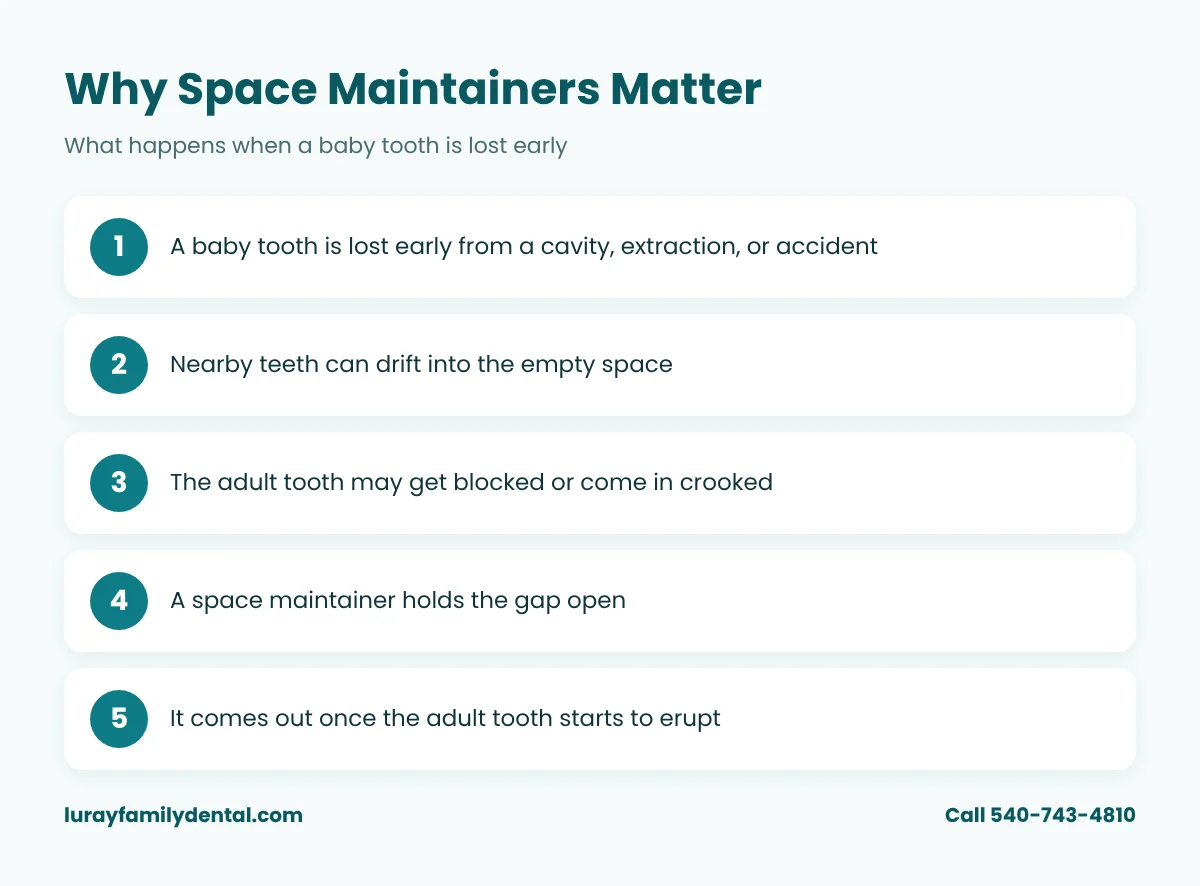
Baby teeth are supposed to fall out on their own schedule. But sometimes a baby tooth is lost early because of a deep cavity, an extraction, or an accident. When that happens, the gap can cause problems for the adult tooth waiting underneath.
Space maintainers are a simple way to keep things on track. Here’s what parents should know, from Luray Family Dental.
Why Do Kids Need Space Maintainers?
Baby teeth act like natural placeholders for adult teeth. When one is lost too soon, the teeth on either side can tip or drift into the empty space. Then the adult tooth may:
- Come in crooked or out of position
- Get blocked and stay stuck in the gum
- Cause crowding of nearby teeth
A space maintainer holds the space open until the adult tooth is ready.
5 Things Parents Should Know
- Not every lost tooth needs one. It depends on which tooth was lost, your child’s age, and how soon the adult tooth will come in.
- They’re custom-made. Each one is made to fit your child’s mouth.
- They don’t hurt. Placing one doesn’t require numbing in most cases.
- Kids adjust quickly. Most children stop noticing it within a few days.
- They can save money later. Holding space now may reduce the need for more complex orthodontic treatment.
Types of Space Maintainers
| Type | How it works | Common use |
|---|---|---|
| Band and loop | A metal band on one tooth with a wire loop across the gap | One missing back baby tooth |
| Lower lingual arch | A wire along the inside of the lower teeth | Missing back teeth on both sides of the lower jaw |
| Nance or palatal appliance | A wire across the roof of the mouth | Missing upper back teeth |
| Distal shoe | A small guide placed under the gum | Before the first adult molar erupts |
| Removable maintainer | Similar to a retainer, can be taken out | Older kids, sometimes with a false tooth |
Most space maintainers are fixed (cemented in place) so they can’t be lost.
What to Expect at the Visit
- First visit: We examine the area, take X-rays to see the adult tooth, and take impressions or a scan.
- Second visit: The space maintainer is fitted and cemented in place. This is usually quick and comfortable.
Caring for a Space Maintainer
- Brush around the bands and wires carefully twice a day
- Avoid sticky candy, gum, and very hard foods
- Don’t push or pull on the wire with fingers or tongue
- Keep up with checkups so we can make sure it fits well
- Call us if it feels loose, bent, or breaks
How Long Do Kids Wear a Space Maintainer?
It depends on when the adult tooth is expected to come in. Some kids wear one for several months, others for a few years. We’ll check your child’s X-rays at regular visits and remove the space maintainer when the adult tooth begins to come through.
Preventing Early Tooth Loss
The best way to avoid needing a space maintainer is to keep baby teeth healthy:
- Brush twice a day with fluoride toothpaste and floss once teeth touch
- Limit sugary drinks and snacks
- Ask about sealants and fluoride treatments
- Treat cavities early; a pulpotomy and stainless steel crown can often save a baby tooth
- Use a sports mouth guard for contact sports
For more tips, read caring for your child’s teeth. The ADA’s babies and kids guide is also a helpful resource.
Space Maintainers and Future Orthodontics
Space maintainers help guide adult teeth into the right place, but some kids may still need braces or Invisalign later. Holding space now often makes future treatment simpler. Compare options in our Invisalign vs braces guide.
Kid-Friendly Care in Luray, VA
Our pediatric team, including Dr. Anna Bondalapati, cares for children from Luray, Stanley, Shenandoah, and across Page County. Learn more in our pediatric dentist guide.
Signs Your Child’s Space Maintainer Needs Attention
- It feels loose or wiggles
- A wire is bent or poking the cheek or gum
- Your child complains of pain or soreness that doesn’t fade
- Food is getting trapped and the gums look red or swollen
- An adult tooth seems to be coming in near or under the appliance
If you notice any of these, call us. Most issues are quick fixes.
Myths About Space Maintainers
- “The gap will close on its own without causing problems.” Drifting teeth are exactly what can block the adult tooth from coming in straight.
- “Space maintainers are the same as braces.” They don’t move teeth; they simply hold space.
- “They’re only for older kids.” Space maintainers can be used for young children too, depending on which tooth is lost.
Frequently Asked Questions
Are space maintainers necessary?
Not always. If the adult tooth is about to come in, or if the lost tooth is a front tooth, a space maintainer may not be needed. Your dentist will check X-rays to decide.
Do space maintainers hurt?
No. Your child may feel some pressure or notice it with their tongue for a few days, but it shouldn’t hurt.
Can my child eat normally with a space maintainer?
Yes, mostly. Avoid sticky candy, gum, and very hard foods that could bend or loosen it.
What happens if a space maintainer comes loose?
Call us and save the appliance if it comes out. We can usually re-cement it quickly.
Where can my child get a space maintainer in Luray, VA?
Luray Family Dental at 156 E. Main St., Luray, VA 22835 provides space maintainers for kids. Call 540-743-4810.
Did your child lose a baby tooth early? Let us check whether a space maintainer is needed. Call 540-743-4810 or request an appointment online.