
Veneers vs Bonding: Which Is Best for Your Smile? (Luray Dentist Guide)
Quick answer: In the veneers vs bonding choice, bonding is the faster, lower-cost option. It uses tooth-colored resin to fix small chips or gaps in one visit and usually lasts 3–10 years. Veneers are thin custom shells bonded to the front of teeth. They take about two visits, cost more, resist stains better, and often last 10–15 years or longer. Bonding suits small fixes, while veneers suit full smile makeovers.
A chipped front tooth, a small gap, or stains that whitening won’t fix can make you hide your smile. Two of the most popular fixes we offer at Luray Family Dental are dental bonding and dental veneers.
Both can give you a beautiful result, but they’re quite different in cost, durability, and process. This guide compares veneers vs bonding so you can pick the right option for your smile and budget.
What Is Dental Bonding?
Dental bonding uses a tooth-colored composite resin that your dentist shapes directly on your tooth. The resin is hardened with a special light, then polished to look like natural enamel.
Bonding is great for:
- Small chips and cracks
- Small gaps between teeth
- Slightly uneven tooth edges
- Covering small stains or spots
What Are Dental Veneers?
Dental veneers are ultra-thin custom shells bonded to the front surface of your teeth. They’re made to match the shape and shade you want. The American Dental Association notes that veneers can change a tooth’s color, shape, size, or length.
Veneers can help with:
- Severe discoloration that whitening can’t fix
- Gaps between teeth
- Misshapen, worn, or chipped teeth
- Slightly crooked teeth (for bigger alignment issues, see Invisalign)
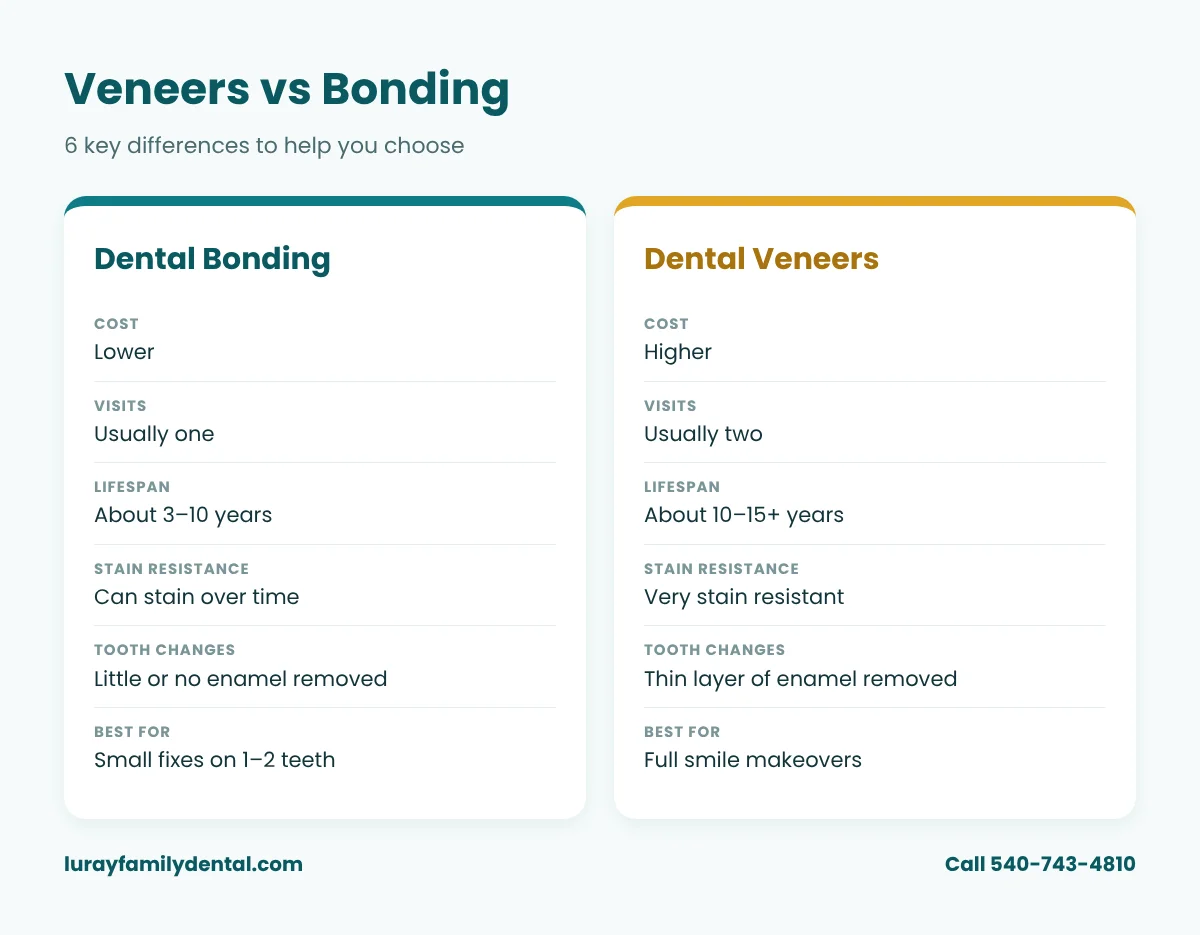
Veneers vs Bonding: 6 Key Differences
| Dental bonding | Dental veneers | |
|---|---|---|
| 1. Cost | Lower | Higher |
| 2. Visits | Usually one | Usually two |
| 3. Lifespan | About 3–10 years | About 10–15+ years |
| 4. Stain resistance | Can stain over time | Very stain resistant |
| 5. Tooth changes | Little or no enamel removed | A thin layer of enamel is usually removed |
| 6. Best for | Small fixes on one or a few teeth | Full smile makeovers |
How the Bonding Process Works
- Your dentist picks a resin shade that matches your teeth.
- The tooth surface is lightly roughened so the resin sticks.
- The resin is applied, shaped, and hardened with a curing light.
- The tooth is polished to a natural shine.
Most bonding visits take 30–60 minutes per tooth, and numbing often isn’t needed.
How the Veneer Process Works
- Visit 1: We talk about the look you want, prepare the teeth, take impressions, and choose your shade.
- Visit 2: Your custom veneers are checked for fit and color, then bonded in place.
Which One Is Right for You? A Quick Checklist
Choose bonding if:
- You have a small chip or gap on one or two teeth
- You want a quick fix in one visit
- You want to keep the cost lower
Choose veneers if:
- You want to change several teeth or your whole smile
- Your teeth are badly stained, worn, or uneven
- You want the longest-lasting, most stain-resistant result
Still not sure about veneers vs bonding? A cosmetic consultation is the best way to decide. We’ll look at your bite, gums, and smile goals together.
Should You Whiten Before Veneers or Bonding?
Yes, if you want whiter teeth overall. Bonding and veneers don’t change color with whitening gels. We usually recommend professional teeth whitening first, then matching your bonding or veneers to your brighter shade.
If your gums look uneven or show too much when you smile, cosmetic gum shaping can make the result even better.
How to Make Your Results Last
- Brush twice a day with a non-abrasive toothpaste
- Avoid biting ice, pens, or fingernails
- Limit coffee, tea, red wine, and tobacco (especially with bonding)
- Wear a night guard if you grind your teeth
- Keep up with regular dental cleanings
Cost and Payment Options
When comparing veneers vs bonding, cost is often the deciding factor. Cosmetic treatments like these usually aren’t covered by insurance unless they repair damage. To make your smile goals easier to reach, we offer CareCredit and Cherry payment plans. Read our affordable dentist guide or see our financial options.
Veneers vs Bonding: Real-Life Examples
Every smile is different, but here’s how we often guide patients:
- One chipped front tooth from a fall: Bonding is usually the quickest and most affordable fix.
- A small gap between the two front teeth: Bonding can close it in one visit. If the gap is large, Invisalign or veneers may give a better result.
- Front teeth that are stained gray and don’t respond to whitening: Veneers usually give the best, longest-lasting color.
- Worn, short, or uneven front teeth from years of grinding: Veneers can rebuild length and shape, often paired with a night guard.
- A full “smile makeover” before a big life event: Veneers on the teeth that show when you smile are the most popular choice.
Other Cosmetic Options to Consider
Sometimes the best result comes from combining treatments, or from a different option entirely:
- Teeth whitening for overall brightness. See our guide to teeth whitening in Luray, VA.
- Invisalign clear aligners for crowding or crooked teeth. Compare options in our Invisalign vs. braces guide.
- Dental crowns when a tooth is badly damaged or weak. Learn about dental crowns in Luray, VA.
- Cosmetic gum shaping for a gummy smile or uneven smile line.
Myths About Veneers and Bonding
- “Veneers look fake.” Well-made veneers are shaped and shaded to look like natural teeth, not overly white “chiclets.”
- “Bonding falls off easily.” Bonding is firmly attached. It can chip with hard biting, but it can be repaired quickly.
- “Veneers are only for celebrities.” Payment plans make veneers possible for many everyday patients.
Why Luray Patients Choose Our Office for Cosmetic Dentistry
At Luray Family Dental, Dr. Ibrahim ElGarawany and our team take time to understand the smile you want before recommending anything. We care for patients from Luray, Stanley, Shenandoah, and across Page County, and our team includes Spanish-speaking staff. Explore all our cosmetic dentistry services.
Frequently Asked Questions
Which lasts longer, veneers or bonding?
Veneers last longer. Most veneers last 10–15 years or more, while bonding usually lasts about 3–10 years before it needs a touch-up or replacement.
Is bonding cheaper than veneers?
Yes. Bonding usually costs much less per tooth than veneers because it’s done in one visit and doesn’t need a dental lab.
Do veneers ruin your teeth?
No. A thin layer of enamel is usually removed so veneers fit naturally, which means the change is permanent. Your natural teeth stay underneath and are protected by the veneer.
Can bonding be done on front teeth?
Yes. Bonding is commonly used on front teeth to fix small chips, gaps, and uneven edges.
Where can I get veneers or bonding in Luray, VA?
Luray Family Dental at 156 E. Main St., Luray, VA offers both dental bonding and veneers for patients across Page County. Call 540-743-4810 for a consultation.
Ready for a smile you love? Book a cosmetic consultation and we’ll help you choose between veneers and bonding. Call 540-743-4810 or request an appointment online.