Cracked Tooth Symptoms: How to Tell, What to Do & Treatment Options
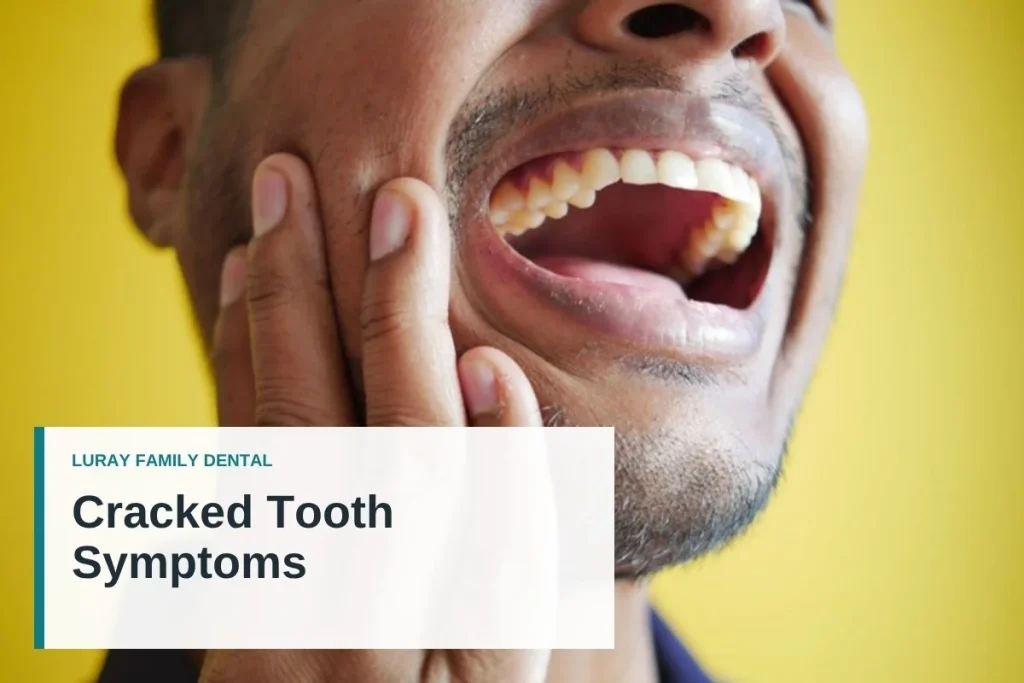
Quick answer: A cracked tooth often causes sharp pain when you bite down or release, sensitivity to hot and cold, or pain that comes and goes. Cracks can be hard to see, so a dental exam is the best way to know. Treatment depends on the crack: small craze lines may need nothing, while deeper cracks are usually fixed with bonding, a crown, or a root canal. See a dentist soon, because cracks can grow over time.
Cracked teeth are one of the trickiest dental problems because they’re often invisible and the pain comes and goes. Many people go weeks wondering why one tooth hurts only sometimes.
This guide from Luray Family Dental explains cracked tooth symptoms, what to do if you think you have one, and how we treat it.
7 Common Cracked Tooth Symptoms
- Sharp pain when biting down, especially on something hard
- Pain when you release your bite
- Sensitivity to hot, cold, or sweet foods
- Pain that comes and goes instead of being constant
- Swelling of the gum around one tooth
- A rough or sharp edge you can feel with your tongue
- A visible line or chip on the tooth
What Causes a Cracked Tooth?
- Biting hard foods like ice, hard candy, or popcorn kernels
- Teeth grinding and clenching (see night guards for teeth grinding)
- Large old fillings that weaken the tooth
- Sports injuries or falls (see our sports mouth guard guide)
- Sudden temperature changes
- Age, since teeth handle years of chewing pressure
Types of Tooth Cracks and How They’re Treated
| Type | What it is | Typical treatment |
|---|---|---|
| Craze lines | Tiny surface lines in enamel | Usually no treatment needed |
| Fractured cusp | A piece of the chewing surface breaks off | Filling or crown |
| Cracked tooth | Crack from the chewing surface toward the root | Crown, sometimes a root canal |
| Split tooth | Crack divides the tooth into parts | Part of the tooth may be saved, or extraction |
| Vertical root fracture | Crack starts in the root | Often extraction |
The American Dental Association recommends seeing a dentist as soon as possible after breaking or cracking a tooth.
What to Do If You Think You Cracked a Tooth
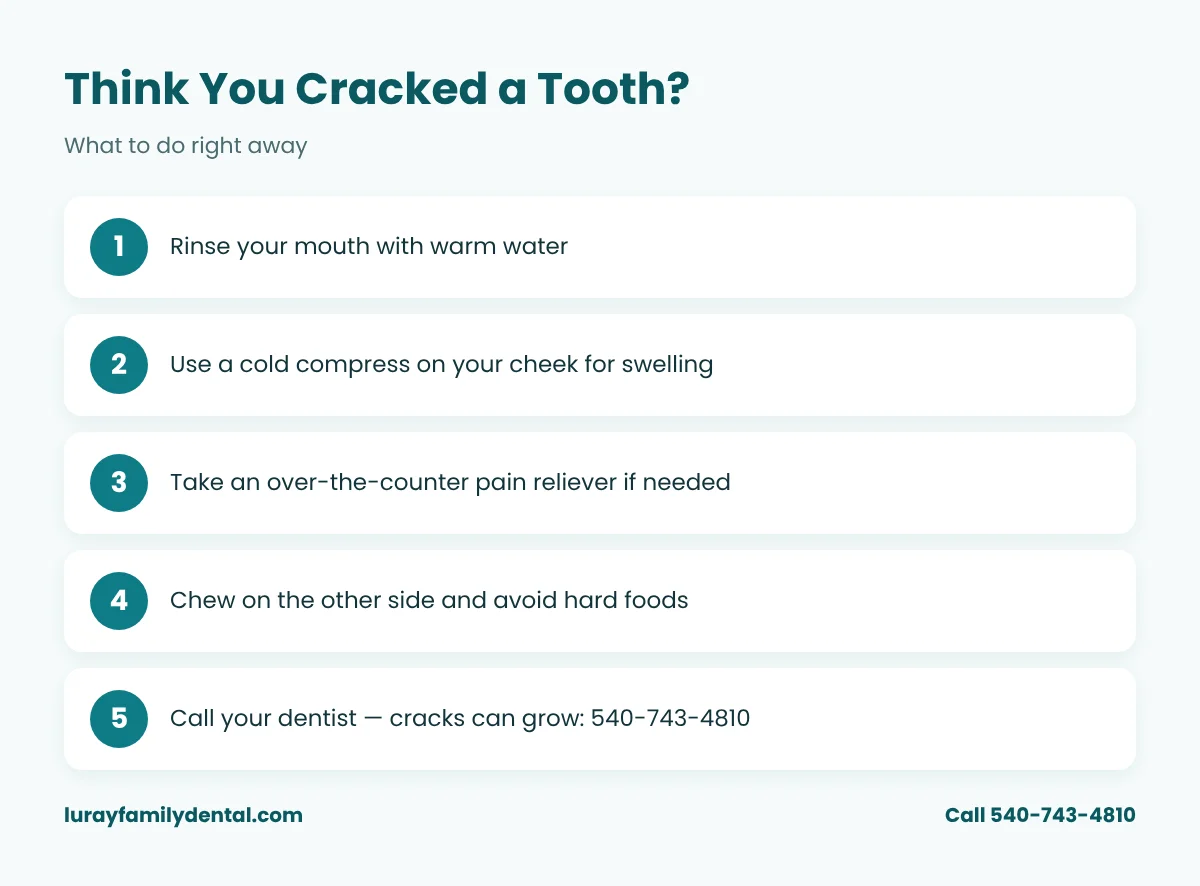
- Rinse your mouth with warm water.
- Apply a cold compress to your cheek if there’s swelling.
- Take an over-the-counter pain reliever if needed.
- Chew on the other side and avoid hard or sticky foods.
- If there’s a sharp edge, cover it with sugar-free gum or dental wax.
- Call your dentist for an appointment.
If you have severe pain, swelling, or a broken tooth after an injury, see our emergency dentist guide.
How Dentists Diagnose a Cracked Tooth
Cracks don’t always show up on X-rays. We may use:
- A careful visual exam with magnification
- An intraoral camera to show you the crack up close
- A bite test on a special tool to find which part of the tooth hurts
- X-rays to check the nerve and bone
Treatment Options for a Cracked Tooth
- Bonding: A small crack or chip can often be repaired with tooth-colored resin (see veneers vs bonding).
- Dental crown: Holds a cracked tooth together and protects it from splitting (see dental crowns).
- Root canal: If the crack reaches the nerve, a root canal followed by a crown can save the tooth.
- Extraction: If the tooth can’t be saved, we’ll remove it and talk about replacing it with a bridge or implant.
Why You Shouldn’t Wait
Cracks can grow. A crack that could be fixed with a simple crown today may reach the nerve or split the tooth later. Early treatment usually means simpler, less expensive care and a better chance of saving the tooth.
How to Prevent Cracked Teeth
- Don’t chew ice, pens, or hard candy
- Wear a night guard if you grind
- Wear a mouth guard for sports
- Replace large, old fillings when your dentist recommends it
- Keep up with regular checkups
Cracked Tooth Care in Luray, VA
At Luray Family Dental, Dr. Ibrahim ElGarawany and our team diagnose and treat cracked teeth for patients from Luray, Stanley, Shenandoah, and across Page County. We’ll show you what we see and explain every option.
Cracked Tooth Myths
- “If I can’t see a crack, there isn’t one.” Many cracks are too small to see without magnification or a bite test.
- “The pain went away, so it’s fine.” Pain that comes and goes is typical, and the crack is still there.
- “A cracked tooth always needs to be pulled.” Most cracked teeth can be saved with a crown or root canal when treated early.
Who Is More Likely to Crack a Tooth?
- People who grind or clench their teeth
- Adults over 40, as teeth wear with age
- People with large fillings or past root canals without a crown
- Athletes in contact sports
- Anyone who often chews ice, hard candy, or nut shells
If you’re in one of these groups, regular checkups help us spot small cracks before they become painful.
Frequently Asked Questions
Can a cracked tooth heal on its own?
No. Unlike bones, teeth can’t heal cracks. Treatment can protect the tooth and stop the crack from spreading.
Is a cracked tooth an emergency?
It depends. Severe pain, swelling, or a broken piece after an injury should be seen right away. A mild crack should still be checked soon, before it grows.
Why does my tooth hurt only when I bite?
Pain on biting or releasing is a classic sign of a cracked tooth. The crack opens slightly under pressure and irritates the nerve.
How much does it cost to fix a cracked tooth?
It depends on the treatment, from bonding to a crown or root canal. Insurance often covers part of the cost, and we offer flexible financial options.
Where can I get a cracked tooth fixed in Luray, VA?
Luray Family Dental at 156 E. Main St., Luray, VA 22835 treats cracked and broken teeth. Call 540-743-4810.
Does a tooth hurt when you bite? Don’t wait for the crack to grow. Call 540-743-4810 or request an appointment online.